
Richland County Criminal Court Records
A criminal court record is the case-level file kept by the court after a criminal matter is filed. In Richland County, the Clerk of Court maintains General Sessions criminal records for felony and higher-court cases. The county describes those General Sessions records as warrants, indictments, sentence sheets, bond papers, and related documents filed with the Clerk. These records differ from arrest reports, jail roster entries, and full criminal-history checks.
South Carolina uses Circuit Court for general trial jurisdiction. The criminal side is General Sessions. Magistrate and Municipal Courts handle lower-level criminal, traffic, bond, warrant, and ordinance matters. The Clerk notes an important boundary: Magistrate Court and Summary Court charges are not included in the Clerk's certified criminal-record checks. The detailed charge path after arrest is covered separately in Richland County court charge records.
The Richland County Sheriff's Department is a law-enforcement source, but it is not the same as the court case file.
Police and sheriff records may explain an incident or arrest, while criminal court records show what was filed and decided in court.
The Sheriff contact and biography page identifies Sheriff Leon Lott and the Sheriff's Department contact channel for agency matters.
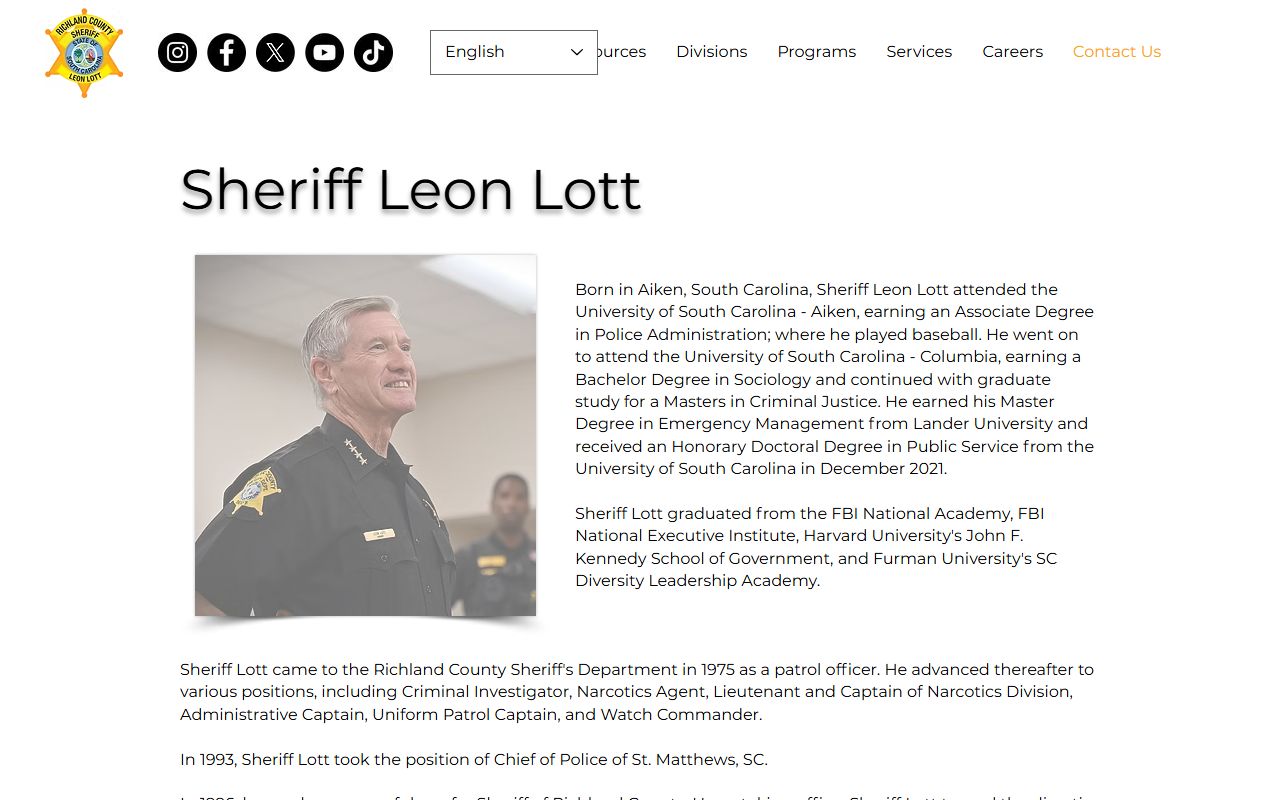
Use that agency route for Sheriff's Department questions, while filed criminal case records remain with the court or Clerk.
Search Richland County Criminal Court Records
The online starting point is the South Carolina Judicial Branch case-records search leading to the Richland Public Index. Search by defendant name or case number, then narrow by court type, court agency, case type, and date range as needed. If the case is a Columbia Municipal Court matter, select Columbia Municipal Court under Court Agency. If the matter is a General Sessions felony case, use the Public Index first and then contact Criminal Records for official copies.
- Open the state case-records search and choose Richland County.
- Accept the disclaimer, complete the security window, enter the code, and click Validate.
- Search by defendant name or case number, using broad filters before adding more limits.
- Open the Case Number link and review actions, financials, parties, document icons, and disposition entries.
- Request certified copies from the Clerk if the online record is not enough for legal use.
For a statewide criminal-history check, Richland County directs users to SLED at 803-737-9000 or SLEDCATCH. That is separate from a court file search because court indexes do not always include every summary charge or every non-court criminal-history item.
Richland County Criminal Case Flow
Richland County criminal court records should be read as a process. A case may begin with an arrest, warrant, summons, indictment, or other charging event. The court file then tracks hearings, arraignment or plea events, motions, trial settings, disposition, sentencing, and payment or bond-related items. Not every case reaches trial. Many resolve by plea, dismissal, diversion completion, or other court action.
Case flow: Charges Filed › Arraignment › Pretrial / Motions › Plea or Trial › Disposition › Sentencing
| Stage | What Happens |
|---|---|
| Charges Filed | A complaint, warrant, indictment, ticket, or other charging document starts the court path. |
| Arraignment | The charge is formally addressed and a plea may be entered. |
| Pretrial / Motions | Attorneys may file requests for court orders, hearings, discovery, or scheduling changes. |
| Plea or Trial | The case may resolve by plea, trial verdict, dismissal, or another court-approved outcome. |
| Sentencing | A sentence sheet may record fines, custody terms, probation, credit, or other conditions. |
What Richland County Criminal Records Show
A Richland County criminal court record can show both the accusation and the outcome. That makes careful reading important. A record may show charges that were amended, reduced, dismissed, or resolved through plea. The docket can show actions and hearings, while the final order, sentence sheet, or disposition entry gives the most useful outcome detail.
| Field | What It Shows |
|---|---|
| Case Number | The court's unique identifier for lookup, copy requests, and court-office routing. |
| Defendant | The person charged in the criminal court case. |
| Charges | The alleged offenses filed in the court record, which may change over time. |
| Warrant or Indictment | Formal criminal filing records that may be part of a General Sessions file. |
| Plea | The defendant's answer to a charge, such as guilty, not guilty, or another plea form. |
| Disposition | The current or final result, such as guilty, dismissed, not guilty, or other court outcome. |
| Sentence Sheet | Fines, custody, probation, bond, or other sentence terms after disposition. |
Richland County Charges vs Convictions
A charge is an accusation filed in court. A conviction is an outcome after a guilty plea, verdict, or other finding that supports conviction. Richland County criminal court records can include charges that do not end in conviction. A dismissed charge, a reduced charge, or an acquittal should not be read the same way as a conviction.
| Charge | Conviction | |
|---|---|---|
| Meaning | An alleged offense filed in court | A final criminal outcome based on plea or verdict |
| Where found | Charging document, warrant, indictment, docket, or jail charge table | Disposition entry, sentence sheet, order, or judgment |
| Can change | May be amended, reduced, dropped, or dismissed | May still be appealed, expunged, or corrected if legally allowed |
Solicitor Role in Richland Criminal Records
South Carolina uses the term Solicitor instead of District Attorney. Richland County is served by the Fifth Judicial Circuit Solicitor's Office for Richland and Kershaw Counties. The Solicitor handles General Sessions prosecution, diversion programs, victim witness functions, expungement, FOIA, and several treatment court programs. Criminal court records may reflect prosecutorial actions, plea negotiations, diversion outcomes, and dismissals tied to those functions.
The Fifth Judicial Circuit Solicitor homepage is the local prosecution source for General Sessions, diversion, victim witness, expungement, and related criminal-court functions.
Solicitor information helps explain why a criminal court record may show diversion, dismissal, plea, or prosecution-specific entries.
The Fifth Judicial Circuit Solicitor biography page identifies the current Solicitor for the circuit.
For prosecution records or Solicitor-held materials, the Solicitor FOIA channel may be separate from the Clerk's court-file copy process.
The Solicitor contact page lists office routing for General Sessions, diversion, DUI Treatment Court, expungement, FOIA, Mental Health Treatment Court, Victim Witness, and Worthless Check functions.
Those contacts are useful when the criminal court record points to a Solicitor program rather than a standard Clerk filing.
Reading Dispositions and Sentences
Disposition means the result of a charge or case. In a Richland County criminal court record, the disposition may show guilty, not guilty, dismissed, nolle prosequi, deferred, or another result depending on the court and case type. A sentence sheet may add the practical terms, such as custody, probation, financial obligations, bond conditions, or credit. Always match the disposition to the correct count or charge, because one case can include more than one charge.
If a person is still in custody, jail records may show current charges, warrant code, bond, bond type, bond court, and offense description. Those jail fields are not the same as the final criminal court record. For custody status, use the county jail lookup rather than assuming the criminal docket is current.
Sealed vs Expunged Criminal Records
Restricted criminal records require care. Rule 41.1 sets a sealing process for civil court records and confirms the open-record principle, but criminal matters may also be affected by expungement rules, juvenile law, diversion outcomes, and court orders. Richland County routes Family Court expungement questions to 803-576-1620, and the Solicitor operates an Expungement function.
| Sealed | Expunged | |
|---|---|---|
| Public view | Hidden from ordinary public access by law or court order | Removed from public access after a qualifying legal process |
| Path | Usually requires a motion, legal basis, and court findings | Requires statutory eligibility, proper agency processing, and required fees where applicable |
| Common limits | Juvenile, confidential, or court-ordered restrictions may apply | Not every criminal case or conviction is eligible for expungement |
Note: Diversion completion may support dismissal or expungement eligibility, but it does not make every case eligible.
Public Access to Richland Criminal Records
Criminal court case files are generally public unless a statute, court rule, or court order restricts access. South Carolina FOIA covers non-exempt public records held by public bodies, while court rules govern judicial records. S.C. Code Section 30-4-30 addresses response timing, fee limits, deposits, and electronic transmission. S.C. Code Section 30-4-40 lists exemptions that may limit release.
Key Statutes:
S.C. Code Title 30, Chapter 4 - sets the state's public-records framework for non-exempt public records.
S.C. Code Title 17, Chapter 13 - addresses arrest and search warrant procedures.
Richland Criminal Copy Requests
Richland County says General Sessions criminal copy requests may be mailed or made in person at the Judicial Center. Criminal Records is on the fourth floor. For warrants, indictments, sentencing, or tickets, the county routes users to Criminal Records at 803-576-1939. General Sessions appearances route to the Solicitor's Office at 803-576-1800, while case roster scheduling routes to 803-576-1932.
The Sheriff's report request page covers incident and accident report limits, not court case copies.
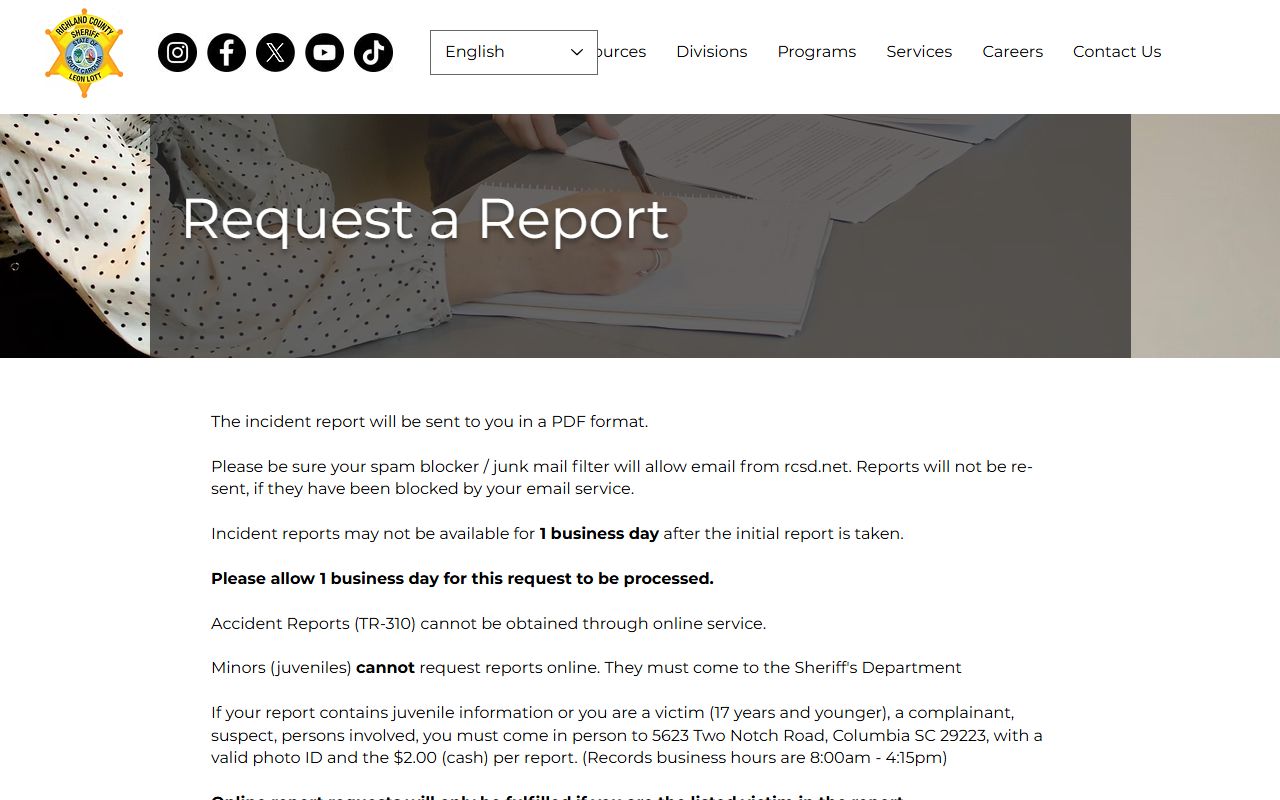
Use the Sheriff report process for eligible law-enforcement reports and the Clerk process for filed criminal court records.
Restricted Richland Criminal Records
Juvenile records, sealed records, expunged matters, confidential reference lists, and certain non-public case events are not available through ordinary public search. Appellate C-Track also excludes non-public, sealed, and confidential cases, events, and documents from public viewing. Public Index images may be unavailable even when the docket exists. If a record is restricted, access may require party status, attorney status, agency authority, or a court order.