
Richland County Arrest Records and Court Charges
Arrest records begin on the custody side. In Richland County, current detainee information is tied to the Alvin S. Glenn Detention Center and the county's public detainee lookup. That tool can show a person who is currently detained, basic physical and demographic fields, booking-related result fields, and a Current Charges area. The charge table can include warrant code, bond, bond type, bond court, and offense description. That is useful for charge research, but it is not the same thing as a complete criminal court case file.
Court charges after arrest move through a court or prosecution path. Richland County is in South Carolina Judicial Circuit 5. Higher criminal matters are handled in General Sessions, the criminal side of Circuit Court. Magistrate and Municipal Courts handle lower-level criminal and traffic matters. The Clerk of Court says General Sessions records can include warrants, indictments, sentence sheets, bond papers, and related documents filed with the Clerk, but the Clerk does not maintain Magistrate or Summary Court charges for a full certified criminal-history check.
The county's Alvin S. Glenn Detention Center page is the official local starting point for custody-related Richland County arrest records.
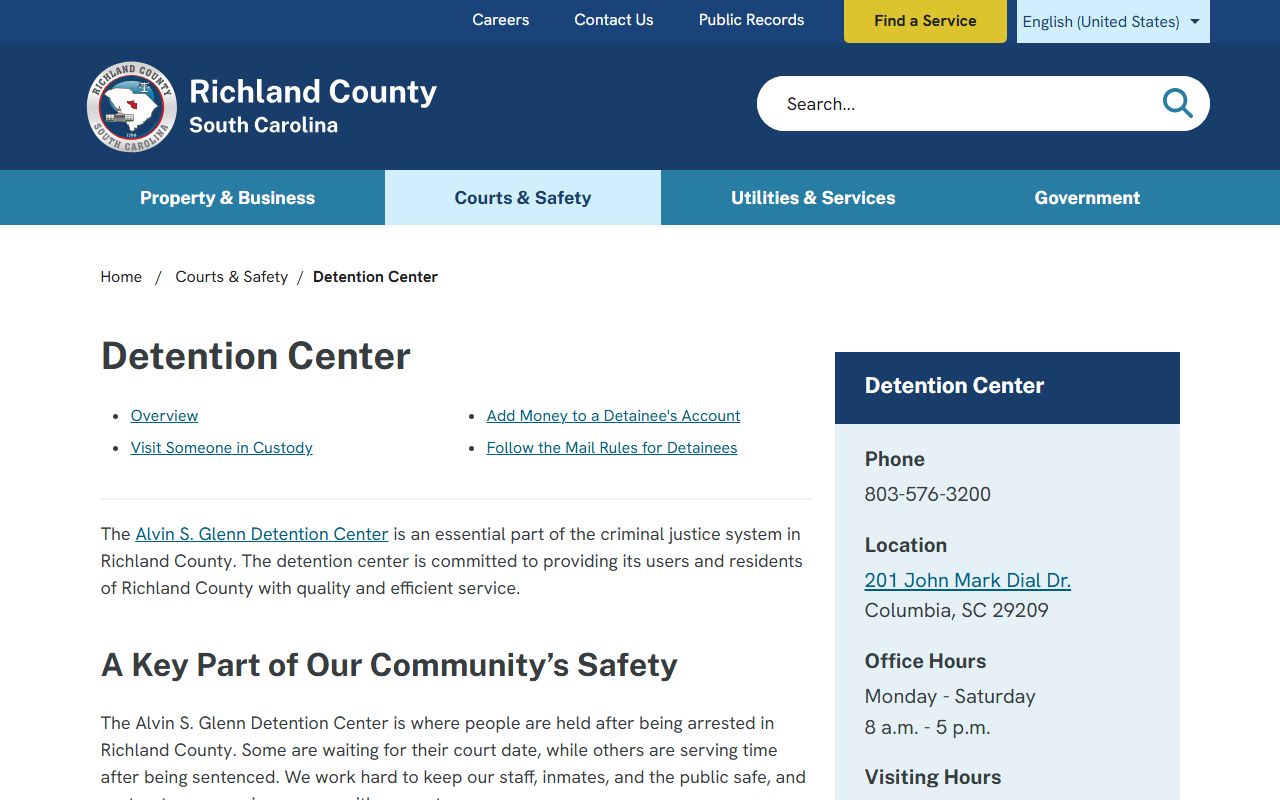
That detention source helps confirm current custody, while court and prosecution sources explain how charges are filed, changed, dismissed, or sentenced.
Find Richland County Arrest Records
A Richland County arrest-record search usually uses more than one official channel. The detainee lookup checks current custody. The South Carolina Judicial Branch Public Index checks court cases by county, case number, name, court type, court agency, case type, date type, and date range. Columbia Municipal Court records are also searched through Public Index by selecting Columbia Municipal Court under Court Agency. SLED CATCH is the statewide route for full South Carolina criminal-history checks when Magistrate or Summary Court charges are outside the Clerk's certified records.
- Search the Richland County detainee lookup for current custody, using the person's last name, first name, and CAPTCHA entry.
- Open any matching detainee profile and review the Current Charges table for warrant code, bond, bond type, bond court, and offense description.
- Search the South Carolina Judicial Branch Public Index for Richland County by defendant name or case number.
- Use the court agency and court type filters to separate General Sessions, Magistrate, or Columbia Municipal Court records when available.
- Call Clerk Criminal Records at 803-576-1939 for General Sessions warrants, indictments, sentencing, tickets, and filed criminal documents.
The Richland County detainee lookup is the official custody search that produced the current-charge field inventory in the research.
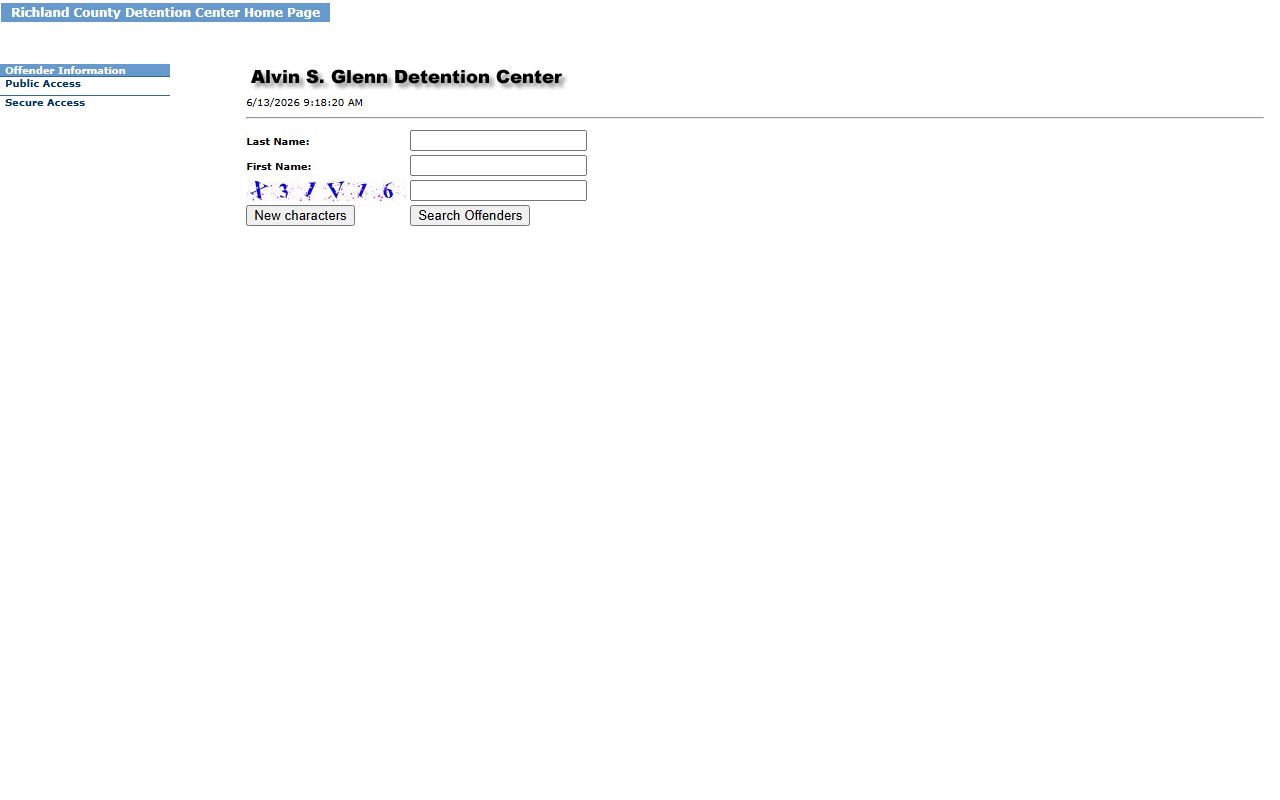
The detainee lookup is strongest when the person is still held locally. Released defendants or sentenced state prisoners may require court records, SLED, or SCDC instead.
Charges After Arrest
After an arrest, the court charge record depends on the document or process that moves the accusation into court. Richland County research confirms General Sessions records can include warrants, indictments, sentence sheets, bond papers, and related Clerk filings. Magistrates issue arrest and search warrants and conduct criminal process in summary matters. The Solicitor, not a district attorney, handles state prosecution in the Fifth Judicial Circuit for Richland and Kershaw Counties.
| Document or Process | Who Uses It | Richland County Context |
|---|---|---|
| Complaint or warrant process | Law enforcement, magistrate, or court officer | Common in lower-level criminal process, arrest warrants, search warrants, and bond-related routing. |
| Indictment | Grand jury and prosecutor | Relevant to General Sessions felony and higher-court criminal records filed with the Clerk. |
| Solicitor filing or prosecution action | Fifth Judicial Circuit Solicitor | Connects the charge to prosecution, diversion, dismissal, plea, trial, or sentencing. |
The full criminal case file, including disposition and sentence, belongs with the Richland County criminal court records path once a case is open in court.
Richland County Charge Status
Charge status can change after a Richland County arrest. A charge may remain pending, be amended, be reduced to another offense, be dismissed, or be resolved by plea, trial, diversion, or sentencing. A charge is an accusation. It is not proof of guilt. The court record should be read for the disposition, sentence sheet, docket actions, and financial tabs where available. Public Index images may not be available in every county or every case.
| Status | What It Means |
|---|---|
| Pending | The charge is still active or unresolved in the court or prosecution process. |
| Amended or reduced | The charge changed, often through prosecution review, plea discussion, or court action. |
| Dismissed | The court or prosecutor ended that charge without a conviction on that count. |
| Nolle prosequi | The prosecutor declined to continue that charge, often shown as a prosecution disposition. |
| Sentenced | The record should be checked for a sentence sheet, bond papers, fines, or other final terms. |
Note: One Richland County arrest can produce several charges, and each charge can have a different bond, court, or final status.
Richland County Charges vs Convictions
Richland County arrest records and charge records must be read with care because a listed charge does not mean a conviction exists. A detainee profile can show current charges shortly after booking. A Public Index case can show filed charges, docket actions, and financial records. The final outcome may be dismissal, plea, trial verdict, diversion completion, or sentence. Background checks may also follow separate rules, especially when the request is for employment, housing, credit, insurance, or another regulated purpose.
| Record Point | Charge | Conviction |
|---|---|---|
| Meaning | An accusation filed or pursued after arrest. | A guilty plea, guilty verdict, or other final finding of guilt. |
| Where It Appears | Detainee current charges, warrants, indictments, Public Index case details. | Disposition, sentence sheet, court docket, and criminal-history results. |
| Can Change | Yes, it may be amended, reduced, dismissed, or declined. | It may later be appealed, sealed, or expunged only if law allows. |
| Best Check | Current charge fields plus court case search. | Final court disposition and certified records where needed. |
Statewide Charge Lookups
SLED CATCH is the statewide criminal-history lookup path referenced by Richland County when the Clerk cannot provide a certified records check across all court levels. The research notes that the Clerk does not maintain Magistrate Court or Summary Court charges and does not perform a certified records check for all criminal history. SLED CATCH is therefore important when the user needs a broader South Carolina criminal-history search rather than a single Richland County court case file.
The South Carolina Department of Corrections public inmate search is a separate state-prison channel. It covers persons currently sentenced to and incarcerated in SCDC as of midnight the previous day. It does not cover released offenders, people sentenced to county detention facilities, parole or probation, juvenile offenders, or current SCDC fugitives. For county custody, the Richland detainee lookup remains the local source.
The SCDC inmate search disclaimer explains the limits of the state prison search and why it should not be treated as a county arrest database.
SCDC helps when a case has moved from local court and jail status to state prison custody after sentencing.
The SCDC public inmate search is the official state prison lookup for currently sentenced people in state custody.
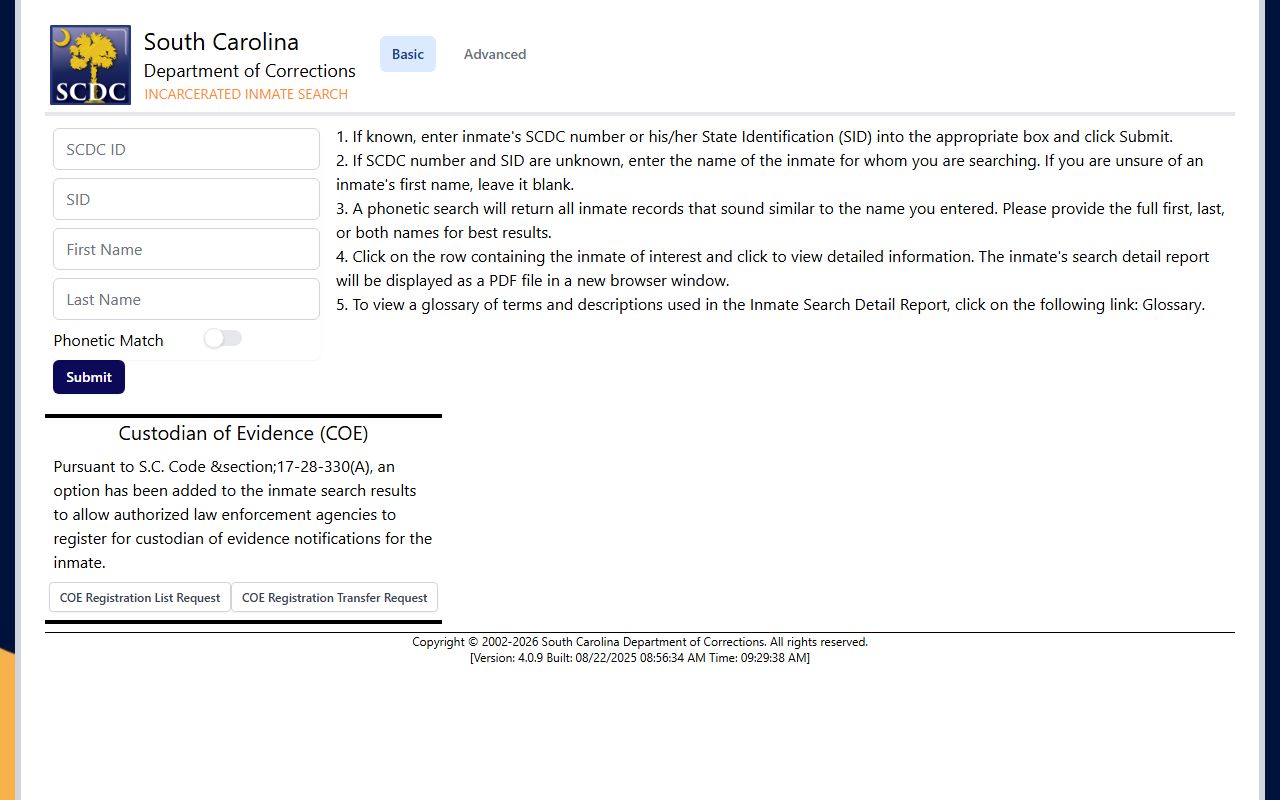
For Richland County arrest records, SCDC is a follow-up source only when the person is no longer in county pretrial or local sentenced custody.
Access to Richland County Charge Records
South Carolina public access rules shape how Richland County charge records are searched and released. Court records are searched online through the South Carolina Judicial Branch and Public Index when available. Certified copies, older records, or non-indexed records route to the Clerk, Magistrate or Municipal Court, Sheriff's Department, Solicitor, or FOIA portal depending on the record type. The county GovQA process may include search, retrieval, redaction, off-site retrieval, deposit, and payment-before-release rules for non-exempt public records.
| Authority or Source | Meaning for Arrest and Charge Records |
|---|---|
| S.C. FOIA, Title 30 Chapter 4 | Allows inspection and copying of non-exempt public records under timing, fee, and exemption rules. |
| Rule 41.1, SCRCP | Sets sealing procedure and confirms open-court and open-record principles. |
| Rule 41.2, SCRCP | Places redaction responsibility on filers and excludes confidential reference lists from Public Index. |
| Richland GovQA | County public-records request portal for non-exempt county records. |
The SLED CATCH portal is the statewide criminal-history channel Richland County points to when a full record check is needed beyond Clerk-held criminal records.
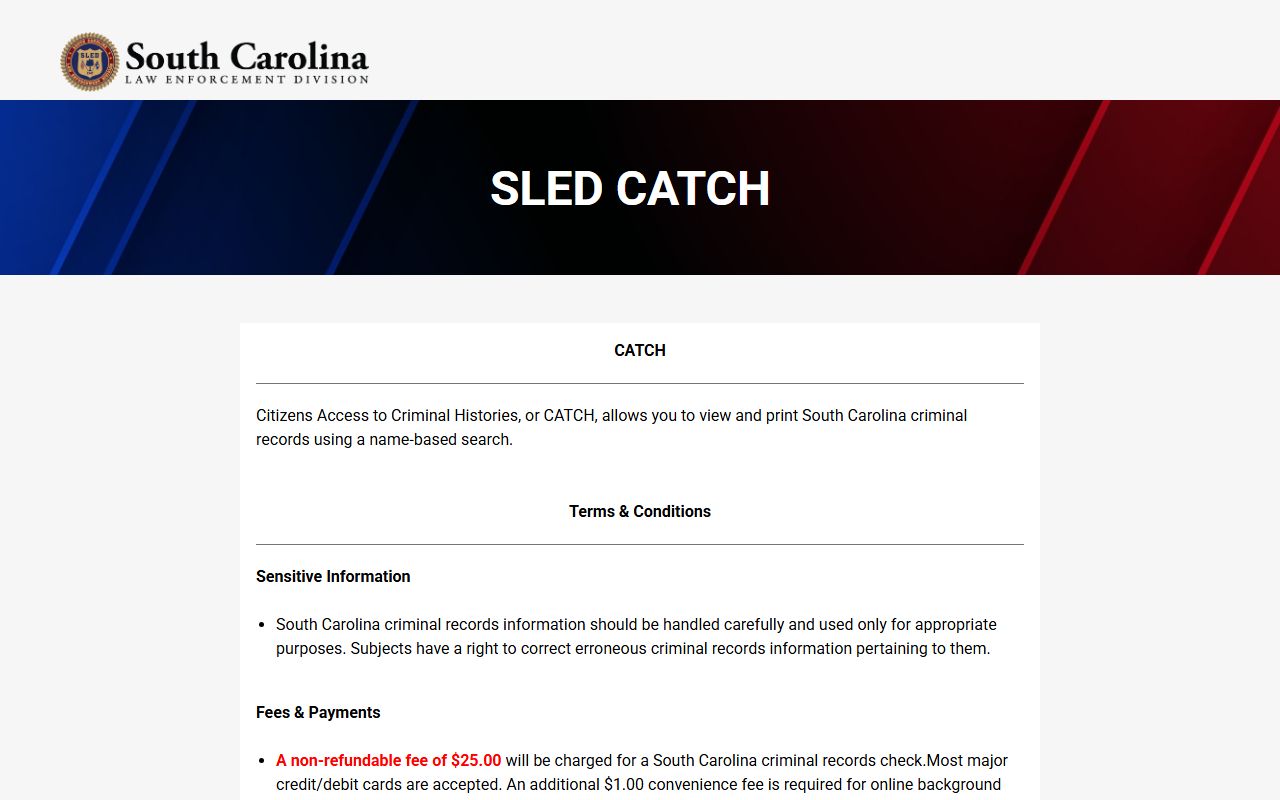
SLED CATCH is not the same as a case docket, but it fills a gap when local court records do not cover every charge level.
Restricted Richland County Arrest Records
Not every Richland County arrest or charge record is open online. Juvenile records are restricted. Adoption and many Family Court materials are confidential. Sealed records are not public unless a court order allows access. Rule 41.2 also means confidential identifiers may be redacted from public filings. Active investigations, search-warrant materials, and sensitive law-enforcement records may be withheld or delayed under state access rules.
Expungement is a separate legal process. The Solicitor operates expungement and diversion functions, and Family Court expungement routes to 803-576-1620. Some diversion programs can lead to dismissal and possible expungement eligibility after successful completion. No one should assume every dismissed, diverted, or old charge can be removed. The correct path is to identify the court and charge, confirm eligibility, and follow the Clerk, Solicitor, SLED, or Family Court process that applies.
| Record State | Public Effect | Richland County Path |
|---|---|---|
| Sealed | Closed from ordinary public access by law or court order. | Confirm with the court that sealed the file. |
| Expunged | Removed from public access if all statutory steps are completed. | Use Solicitor, Clerk, SLED, or Family Court expungement routing as applicable. |
| Redacted | Public copy remains available with confidential data masked. | Review Public Index images or request a clerk copy when allowed. |