
Search Richland County Court Records
The main online path for Richland County court records is the South Carolina Judicial Branch Case Records Search, which routes users to the Richland County Public Index. Richland is listed as Judicial Circuit 5 and County Number 40. The public index works best when cookies and JavaScript are enabled, and the official state guide notes that some browsers need a pop-up exception before case detail screens display correctly.
The Richland Public Index can be searched by case number, party name, action type, date type, date range, tax map number, court type, court agency, case type, case subtype, and party type. A broad name search can return too many results. Starting with one or two known filters, then adding date or court filters, is usually a better way to search Richland County Court cases.
- Open the South Carolina Judicial Branch case records page and choose Richland County from the county list or map.
- Read the county disclaimer, accept the terms, and complete the security-code validation.
- Search by case number if known. If not, use a party name, date range, court agency, or case type.
- Select the case number link in the results to view case detail, actions, financial tabs, and available document icons.
- Contact the Clerk of Court, Probate Court, Magistrate Court, Municipal Court, or agency record office for certified copies or records not shown online.
The South Carolina Judicial Branch is the statewide entry point for court information and public index access.
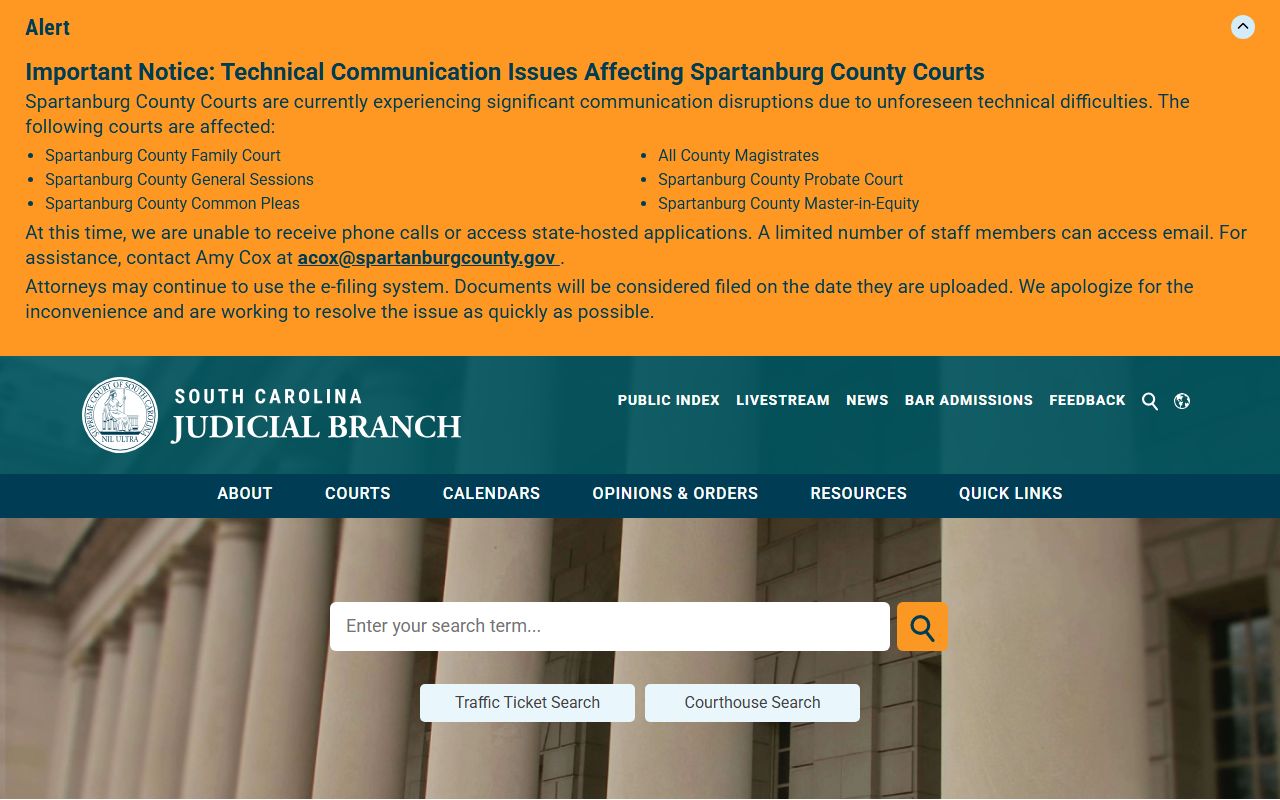
That statewide entry matters because Richland County records are part of South Carolina's unified court system, not a separate county-only court database.
Richland County Court System
South Carolina uses a unified judicial system. In Richland County, the Circuit Court is the general jurisdiction trial court. It has two main sides: Common Pleas for civil cases and General Sessions for criminal cases. Family Court handles divorce, custody, support, juvenile, adoption, name-change, and protection matters. Probate Court handles marriage licenses, estates, guardianships, conservatorships, commitments, trusts, and related filings.
Summary-level matters are split across Magistrate Court and Municipal Court. Richland County Magistrates handle small claims, landlord-tenant matters, lower-level criminal matters, traffic hearings, bail, preliminary hearings, and arrest or search warrants. Municipal Courts handle ordinance, traffic, and lower-level criminal cases inside city or town limits. Columbia Municipal Court records are maintained through the Richland County Public Index by selecting Columbia Municipal Court as the court agency.
| Court or office | Main role in Richland County | Record examples |
|---|---|---|
| Circuit Court, Common Pleas | Civil trial court | Complaints, motions, judgments, foreclosure filings |
| Circuit Court, General Sessions | Felony and higher criminal court | Indictments, sentence sheets, bond papers, warrants filed with the Clerk |
| Family Court | Domestic and juvenile matters | Divorce, custody, support, juvenile, name-change records |
| Probate Court | Probate and marriage-license matters | Estates, wills, guardianships, conservatorships, marriage licenses |
| Magistrate Court | Summary civil, criminal, traffic, and warrant matters | Small claims, lower criminal cases, bond and warrant records |
| Municipal Court | City and town ordinance, traffic, and lower criminal cases | Municipal tickets, bench warrants, payment records |
Where Richland County Records Are Kept
Richland County court records are not held by one office. The Clerk of Court keeps Circuit Court and Family Court records, including Common Pleas, General Sessions, and family filings. The Probate Court keeps estate, marriage, guardianship, conservatorship, and related probate records. Magistrate and Municipal Courts keep summary-level criminal, traffic, bench-warrant, and small civil records tied to their court level.
The South Carolina Judicial Branch Richland courthouse listing identifies the county courthouse, Clerk, judges, magistrates, and municipal courts. It is a useful official check when a record search turns on the court location or agency name.
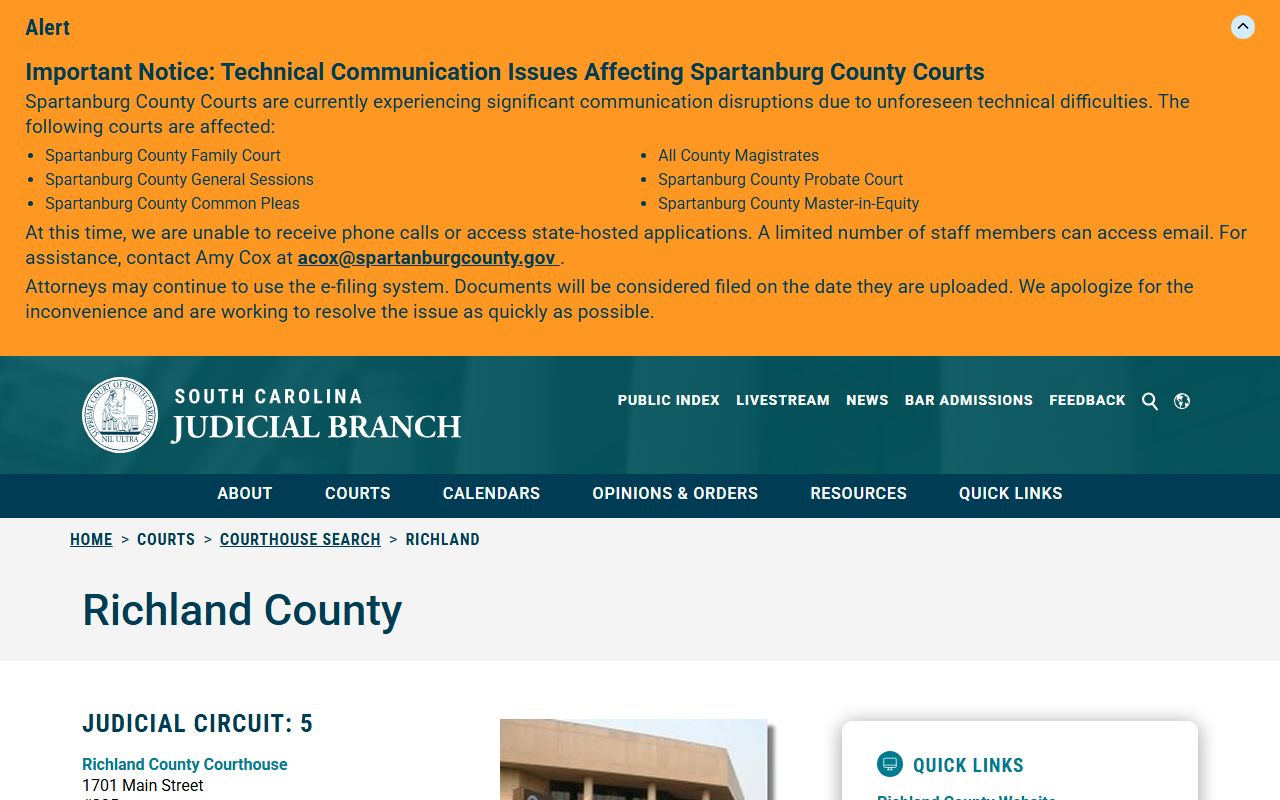
The courthouse listing helps separate Circuit, Family, Probate, Magistrate, and Municipal contacts before a request is sent to the wrong office.
Richland County Judicial Center
1701 Main St., Columbia, SC 29201
803-576-1950
Clerk of Court, Circuit Court, Family Court, Probate Court
Central Court
2500 Decker Blvd., Columbia, SC 29206
803-576-2300 ext. 5
Magistrate, Central Court, and Master-in-Equity functions
Bond Court
201 John Mark Dial Drive, Columbia, SC 29209
803-576-3281
Bond hearings and warrant-related court appearances
Richland County Court Record Types
Civil records in Richland County include complaints, summonses, answers, motions, orders, judgments, foreclosure materials, lien or judgment entries, property disputes, contract cases, injury cases, and Master-in-Equity filings. Criminal records in General Sessions include felonies and higher-court matters, with records such as warrants, indictments, sentence sheets, bond papers, and documents filed with the Clerk.
Family Court records cover divorce, custody, visitation, support, adoption, juvenile, protection, name-change, and domestic matters. Probate records include wills, estate packets, inventories, accountings, creditor claims, deeds of distribution, small-estate affidavits, guardianships, conservatorships, commitments, and marriage-license records. Traffic records may sit in Magistrate Court, Municipal Court, the Public Index, the traffic-ticket search, or the SCDMV driver record system depending on the issue.
- Court records: Circuit, Family, Probate, Magistrate, Municipal, and Master-in-Equity files, depending on case type.
- Criminal records: General Sessions case files, summary-court matters, Solicitor records, and SLED background checks.
- Charge records: jail current-charge tables, warrant codes, bond fields, and formal court charges after filing.
- Inmate records: current detainee lookup details for Alvin S. Glenn Detention Center and sentenced-prisoner searches through SCDC.
- Vital and probate records: marriage licenses, divorce decrees, estate records, and probate copy requests.
What Richland County Court Records Show
Public Index case details can show the case number, parties, case type, court agency, docket actions, financial entries, and document icons when online images are available. The official guide notes that enabled tabs appear in bold, and the Switch View option can show available case information on one screen. Images may not be available in every county or for every case.
Criminal court records may show charges as filed, indictments, bond papers, sentence sheets, hearing events, pleas, disposition, and sentence. A charge is not the same thing as a conviction. A charge describes what was filed or alleged. A conviction means the case ended with a guilty plea, verdict, or other finding that creates a criminal judgment.
| Field | What it can show |
|---|---|
| Case number | The court's unique identifier for the Richland County case. |
| Court agency | The court or office tied to the record, such as Columbia Municipal Court or Circuit Court. |
| Action type | A filing or event category such as motion, judgment, foreclosure, or other case action. |
| Financial tab | Fines, fees, balances, and payments when financial data is available. |
| Document icon | A link to an image when the court makes that document viewable online. |
| Disposition | The final or current result of the case, charge, or claim. |
Richland County Public Access Rules
South Carolina public-record access is shaped by S.C. Code Title 30, Chapter 4, often called FOIA, and by court rules that govern judicial records. FOIA allows inspection or copying of non-exempt public records under timing, fee, and exemption rules. Richland County uses the GovQA portal for county public-records requests when a record is not available through a direct court portal.
Judicial records also have court-specific limits. Rule 41.1, SCRCP sets the sealing process and recognizes open-court and open-record principles. Rule 41.2, SCRCP places redaction duties on parties and counsel, not on clerks reviewing every filed page. Rule 610, SCACR governs bulk and compiled judicial-record requests.
Key point: online access, courthouse viewing, certified copies, FOIA requests, and sealed-record motions are different access paths.
Restricted Richland County Records
Not every Richland County court record is public. Juvenile and adoption records are not ordinary public civil records. Probate mental-health or lunacy records are confidential even though estate records are public. Sealed records are closed by law or court order, and non-public appellate events or documents do not appear in the public C-Track system.
Public Index images may also be limited. Rule 41.2 makes filers responsible for redacting confidential information, and confidential reference lists are excluded from the public index. Some images can be removed from online display if they are highly inflammatory or harmful, even when courthouse access may still exist under court rules.
- Sealed record
- A record closed from public access by statute or court order.
- Redaction
- The masking or removal of confidential data before a document is public.
- Expungement
- A legal process that removes qualifying records from public access after statutory steps are met.
- Disposition
- The final or current outcome of a case, claim, or charge.
Richland County Clerk Services
Richland County Clerk of Court Jeanette W. McBride oversees Common Pleas, General Sessions, and Family Court records. The Clerk's office is in the Richland County Judicial Center, Room 205, with mailing through P.O. Box 2766, Columbia, SC 29202. The office phone is 803-576-1950, and the county lists weekday office hours as 8:30 a.m. to 5 p.m.
Direct phone routing matters. Civil records, certified copies, and 2005 or prior divorce decrees route to 803-576-1952. Divorces from 2006 forward, name changes, child support, and family matters route to 803-576-3326. Warrants, indictments, sentencing, and tickets route to Criminal Records at 803-576-1939. Fine payments route to 803-576-1949.
The Clerk's official page gives the county office context and points users to the correct local office for Circuit and Family Court records.
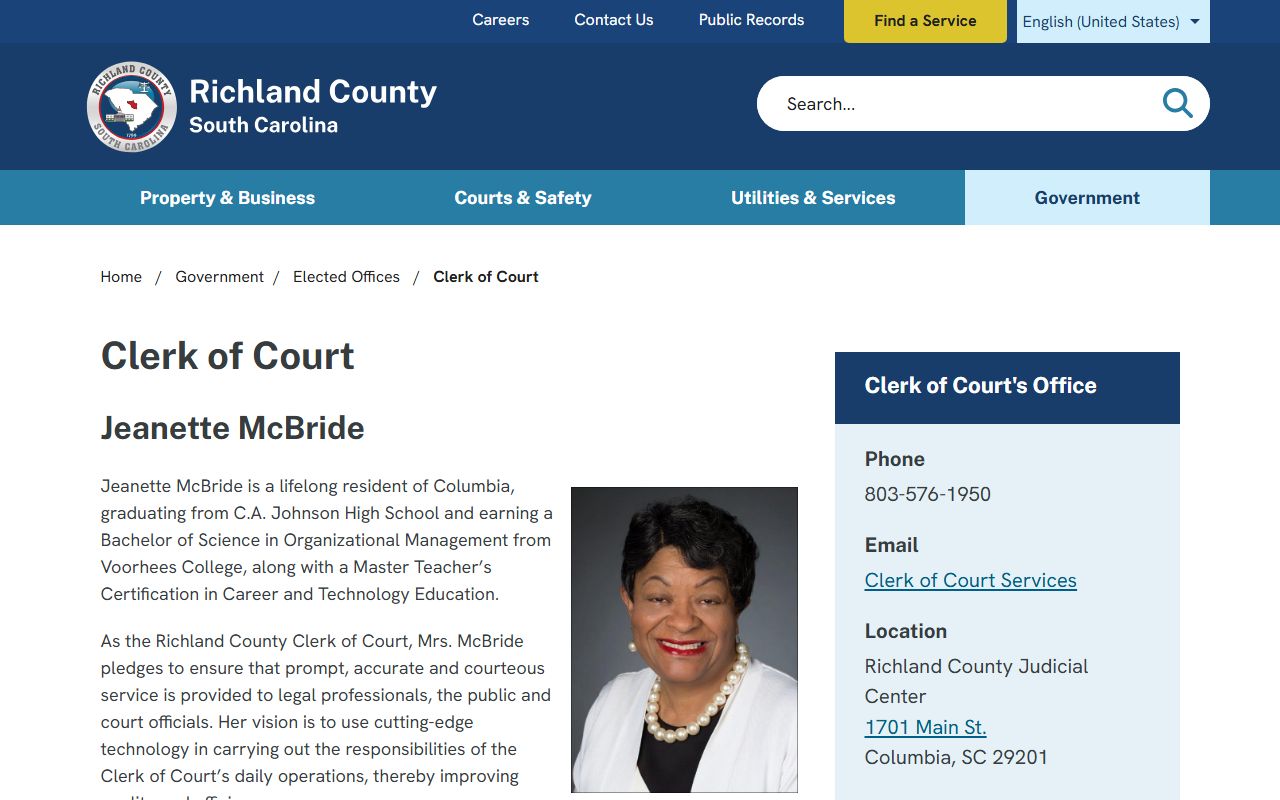
The Clerk is the main local contact for certified Circuit and Family Court records that are not complete through an online search.
Richland County Criminal and Jail Records
General Sessions handles felonies and serious misdemeanors in Richland County. Those criminal court files can include warrants, indictments, sentence sheets, bond papers, and related filings. Magistrate and Municipal Courts handle lower-level criminal and traffic matters, so a criminal search may require both the Public Index and the correct summary court contact.
The Alvin S. Glenn Detention Center houses adults waiting for trial or court dates and people serving sentenced time locally. The county detainee lookup can show current custody status, a current-charge link, warrant code, bond, bond type, bond court, and offense description. That jail profile is not the same as a full criminal case file, and it is not a complete warrant registry.
For full South Carolina criminal-history checks, Richland County directs users to SLED and the SLED CATCH background-check system because Clerk records do not include all Magistrate or Summary Court charges.
Richland County Warrants and Bond Court
No official public active-warrant list was found for Richland County on county or Sheriff's Department pages. Warrant-related information may appear in General Sessions records, Magistrate or Bond Court channels, Municipal Court cases, or a detainee profile after arrest. The practical first step is to identify the court level before calling or requesting records.
Magistrates issue criminal arrest and search warrants and conduct bail hearings. Bond Court is located on the Alvin S. Glenn campus and can be reached at 803-576-3281. General Sessions warrant, indictment, sentencing, and ticket records route to the Clerk's Criminal Records line at 803-576-1939. Columbia Municipal Court cases can be searched through the Public Index by selecting Columbia Municipal Court as the court agency.
Resolution path: identify the court level, search the Public Index when available, call the direct court or records number, and consult counsel before surrendering on an outstanding warrant.
Richland County Traffic Records
Richland County traffic court records may be handled by Magistrate Court, Columbia Municipal Court, Forest Acres Municipal Court, Irmo Municipal Court, or another municipal venue. The county traffic court page says full citation amounts may be paid online by credit card, partial online payments are not accepted, and some charges still require a mandatory court appearance.
The SC Judicial Branch traffic ticket search supports citation-number, driver-license, and name/date-of-birth search modes. The SC.gov traffic payment workflow routes users by county or municipality, then asks for the ticket or case number and last name. Payment may waive contest rights, so a person who wants to contest a ticket should contact the court first.
| Court traffic record | SCDMV driver record |
|---|---|
| Shows citation, court, charge, fine, disposition, and docket events. | Shows points, convictions, license status, and suspension status. |
| Accessed through court, Public Index, ticket search, or payment tools. | Ordered through SCDMV online or the MV-70 process. |
| Corrected through the issuing court or clerk. | Corrected through SCDMV after court data updates. |
Richland County Marriage and Probate
Richland County Probate Court issues marriage licenses and keeps probate estate records. Marriage-license applications are online only, require document uploads from both applicants, and have a 24-hour waiting period after application. Certified marriage-copy searches require Party A and Party B names. South Carolina DPH has marriage certificates for July 1950 through December 2023, but Richland Probate Court is the local source for county-issued licenses and recent county records.
Probate estate records are public, but mental-health and lunacy records are confidential. Richland County estate records cover 1900 to present. Records from 1900 through 1982 are on microfilm, while records from 1983 forward are scanned and available through public computer access or the online estate inquiry. The estate inquiry can show case number, decedent name, date of death, open and close dates, estate clerk email, parties, and document-access options.
| Service | Richland County detail |
|---|---|
| Online marriage application | $45.24 |
| Marriage certified copy | $8 per copy |
| Estate search before 1983 | $3 per file requested |
| Estate copies | $0.50 per page |
| Probate certified copies | $5 |
Richland County Specialty Courts
The Fifth Judicial Circuit Solicitor serves Richland and Kershaw Counties. Its programs include Adult Drug Treatment Court, DUI Treatment Court, Mental Health Treatment Court, Veterans Treatment Court, Columbia Homeless Court, Juvenile Drug Treatment Court, Alcohol Education, Pre-Trial Intervention, Traffic Education, Expungement, and Worthless Check.
These programs can affect court records because successful completion may lead to dismissal or expungement eligibility when the program and court rules allow it. Adult Drug Treatment Court is a structured outpatient program of at least 12 months. Mental Health Treatment Court requires admission through the Solicitor and judge, and successful completion can result in dismissal. Veterans Treatment Court was created in November 2011 and is described by the Fifth Circuit as South Carolina's first program of its kind.
Richland County Court History
Richland County was formed in 1785 from part of Camden District. The South Carolina Archives notes that a February 1865 courthouse fire during the federal occupation of Columbia destroyed the courthouse and most records inside it. Equity and probate records mostly survived because they had been removed before the fire.
That history matters for older record searches. Archives holdings show Court of Common Pleas civil journals from 1865 to 1900, General Sessions indictments from 1866 to 1957, Court of Equity records from 1793 to 1868, Court of Ordinary estate books from 1787 to 1839, Probate Court estate papers from 1787 to 1909, marriage records from 1911 onward, and Magistrates Court criminal dockets from 1847 to 1944.
The county's public-records page is the local FOIA access point for records that are not available through a specific court portal.
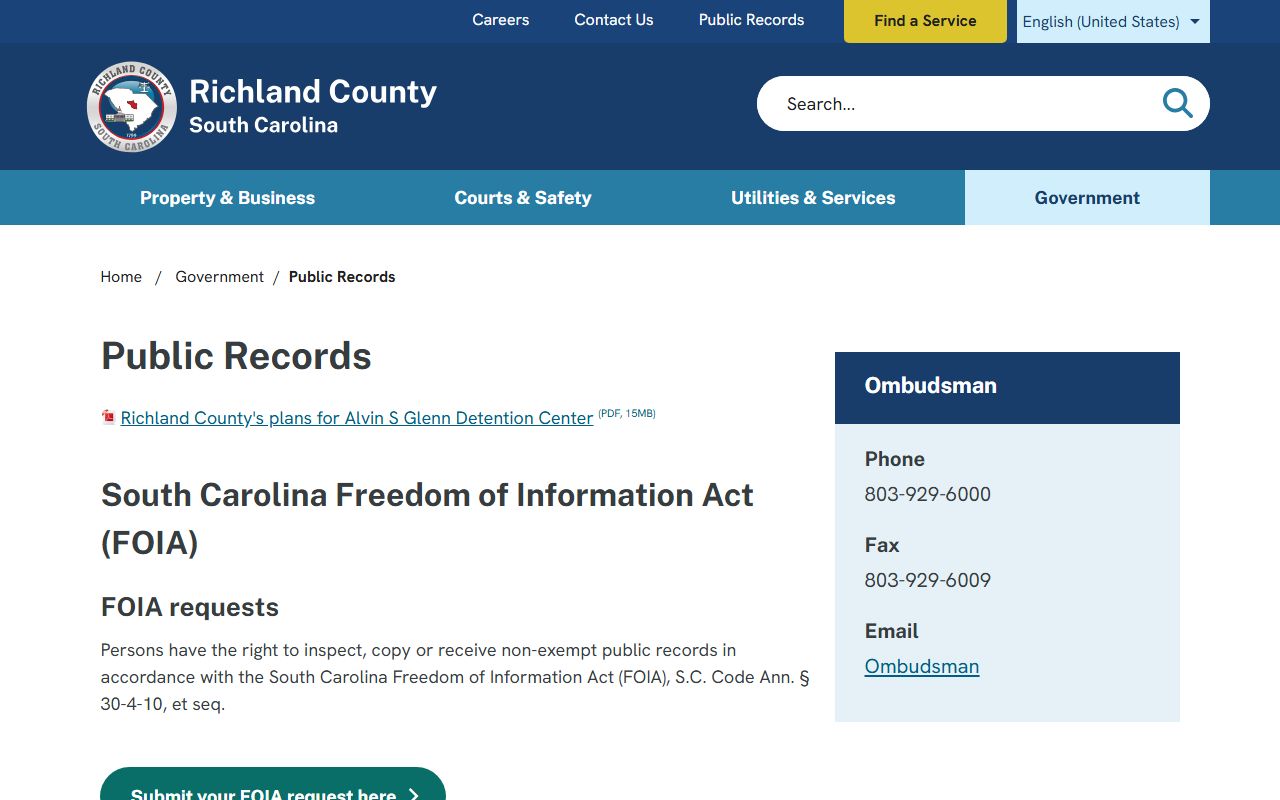
FOIA is useful for non-exempt county records, but court records still route first through the court or office that keeps the file.
Richland County Court Records FAQ
Can Richland County court records be searched online? Many trial-court records can be searched through the South Carolina Judicial Branch case records search and the Richland Public Index. Some older, sealed, confidential, or non-indexed records require the Clerk, Probate Court, Magistrate Court, Municipal Court, or an agency request.
Who keeps Richland County criminal court records? General Sessions criminal records are kept by the Richland County Clerk of Court. The county says those records include warrants, indictments, sentence sheets, bond papers, and related filings. Magistrate and Municipal criminal matters are separate summary-court records.
Where are Richland County inmate records searched? Current county detainees are searched through the Richland County detainee public information system. Sentenced state prisoners are searched through SCDC, which does not cover current county detainees or released offenders.
Are probate estate records public? Richland Probate Court says estate records are public. Mental health and lunacy records are confidential. Estate records after 1983 can be searched online, while older records require Probate Court access or an order form.
Is there a public active-warrant list? No official Richland County public active-warrant list was found in the research. Warrant-related checks route through Public Index searches, Clerk Criminal Records, Magistrate or Bond Court, Municipal Court, or jail charge fields after arrest.
Public Record Search
Sponsored Results